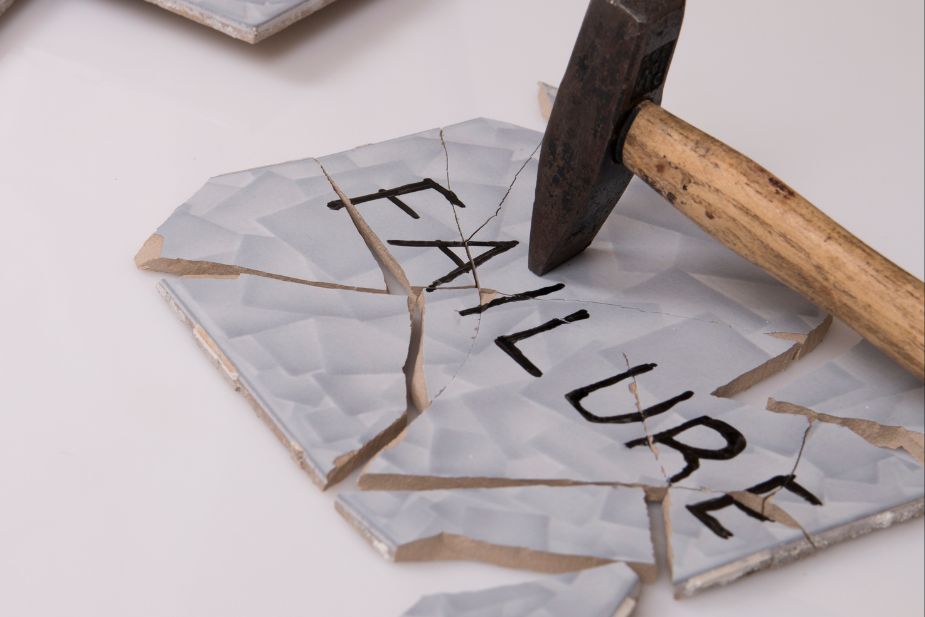
I’ve had a messed up relationship with failure.
I have always felt he is a vicious villain who has more power than me.
So, whenever he appears in my life, I feel powerless and surrender.
Failing at something hurts my ego.
I had the best plan, I did everything I could and still failure scored the point.
It felt like he was mocking my efforts, hard work and dreams.
I had handed over all the power to failure and my ego was too big to try again.
But eventually I do try again only after weeks or months. And just do the same thing again, without making any changes
I think if I try harder (doing the wrong thing) again I would beat failure this time.
But guess what failure won again.
I did this for years and finally I decided to fix my relationship with failure. Because like it or not he is going to stay here.
So, this is how I learnt to overcome failure.
A. The Foundation
This comes before everything else. Because no action or habit will work if you haven’t changed the way you see failure first.
1. Redefine Failure
Many of us hate failure. It’s like an unwelcome guest – we don’t want it in our life but it makes its presence known every now and then.
None of us do something to fail at it. We all want to succeed, no matter what it is – be it an interview, exam, starting a side hustle or anything else.
Even though, we want to succeed at something, failure will show up.
And when it does. Floodgates of emotions burst open and it feels like you can’t control it.
And not to mention your self-confidence and self-esteem get a huge hit too.
This is all happening because we have made up our mind that failure isn’t supposed to be in the picture.
As if it’s a vicious, powerful villain whose only motive is to destroy everything we are doing.
But it’s not.
Failure is not a villain. Neither is success a hero.
Both of these are part of the process. These are data that are showing what is going wrong and what is going right so that we can improvise and move forward.
One cannot exist without the other.
It’s humans who decided to give more importance to one side of the coin than the other because it looked and felt good.
The smart ones who understood that both are important and come as a package accepted this. They tried to understand what each of them is conveying and built up on it.
Both failure and success are data and you are the data analyzer who has to make sense of what they are saying.
Once you see it like this you will be emotionally detached from failure. This will help you to stay grounded and move forward despite success or failure.
You shouldn’t be blinded by failure or success.
Your job is to understand the patterns and learn from both – especially failure. Because it teaches you more than success ever can.
B. Short Term Actions
This is what you do the moment failure shows up. The hours, days or weeks right after. How you feel it, face it and get back up.
2. Grieve Your Efforts
Efforts and time are invested every time you try to do something.
You might have sacrificed sleep, fun, time with friends and family. Not to mention the effort put into research and practice and actually doing it.
When these don’t bring the desired results, it’s very normal to feel a mix of emotions.
Nobody feels happy that they failed, even though it’s a part of the process.
Redefining failure doesn’t instantly take the emotion out of it. You will still feel sad, angry, frustrated and just want to give up.
Instead of fighting these emotions, allow them to exist.
Take out some time to grieve your efforts and time invested. Accept that this time you didn’t get the desired results.
Honor the emotions and give space for them to exist. Then you can access the analytical side of the brain to act as a data analyzer and see what went wrong.
Now comes the next question:
a. How much time?
There is no fixed answer for this question. It really depends on how much effort you put in, how much what you were trying to achieve mattered to you.
Maybe a good night’s sleep is enough or maybe a weekend where you stay away from the project and immerse yourself in the regular life by doing the things you put on hold.
Or maybe you need more than that. Only you can decide this.
Make sure that you are not consumed by your emotions during this time.
The time spent is to not to spiral down on why this happened and if I did that and why I didn’t see this before.
Nope.
It is not to be consumed by the grief and the pain. It is to accept that this happened and bounce back.
b. What to do?
Two options:
1.Journal:
Open up a blank page and write whatever comes into your mind.
Free write. Dump everything. After some time you will be able to make sense of your emotions.
Or at least it’s off your mind. Either way it’s a good outcome.
Related Post: 28 Effective Journaling Tips that’ll Help You Start Journaling
2. Talk to friends or family:
If you have someone in your life with whom you can share your thoughts and how you are feeling, this is the best way.
They can hold you and give you the courage to try again or move forward.
Failure is the stepping stone to success.
But you are not a robot.
Failure hurts and takes some time to process it before moving forward.
3. Analyze The Data
Once the emotions are taken care of, it’s time to wear the hat of a data analyzer.
A scientist doesn’t spiral when experiments go wrong. They look up the data and understand what went wrong and what went right.
Take notes on it and try again.
Start with three simple questions?
1. What went wrong?
Was it the plan? The execution? The timing? Or something that’s completely out of your control?
2. What went right ?
This is something people skip entirely when they fail. Even if the end result was failure, few elements of the process went right. What were they? Take time to identify those too.
3. What did you discover?
Sometimes failure doesn’t show what went wrong. It helps you discover something you didn’t know about. It can be about the subject, the process or yourself.
Failure is trying to teach you something.
Unless you pause to reflect, understand and learn from it, you will keep on facing failure again and again.
Once you start asking these questions, failure stops becoming a roadblock and becomes a redirect.
4. Use Failure as a BS Filter
Do you really want something or do you like the idea of achieving it?
Sometimes, you might feel like your dreams and goals really matter because it might excite you or look good on the outside.
Only when you start working on it will you understand that it might not be for you.
The goals seem exciting but the process isn’t. If the process doesn’t excite you, both failure and burnout will find you.
And it’s ok to realize this once you begin something.
Many have realized that their dream job sucks after they have failed at a project at work. It seemed great, promising and fun but it wasn’t.
So, how to use failure as a BS test?
If you failed and the first thought that comes to your mind is ‘How do I fix this? What went wrong?’ even if you are hurt then this truly matters to you.
Use failure as a BS test will help you overcome failure faster.
Because it helps you understand that just because you started something you don’t need to continue it.
It helps to restart and adjust your journey.
5. Celebrate the Failure
You know what failure means – it’s a proof that you tried something, gave your best and maybe even got out of your comfort zone.
And that needs to be celebrated.
You tried!
Talk about your failures. Record them.
Don’t shy away from it. Don’t make it a closed chapter of your life.
Here are two ways to do this:
a. Build a failure resume or keep a failure journal
Tina Seelig, a professor at Stanford, popularized the idea of a failure resume. It’s exactly what it sounds like – a document where you list everything that didn’t work out.
Document every rejection, every plan that collapsed, everything that didn’t work out.
Your failure resume isn’t a list of your worst moments. It is the proof that you tried something, went out of your comfort zone, attempted to achieve your dreams and goals.
If a formal document feels too much, try a failure journal.
It’s more informal and it becomes a private record of your resilience.
Failure is also a part of your legacy. It deserves to be documented and celebrated.
b. Talk about it. Even laugh about it
Talk about your failure openly to your closest friends and family – your strongest cheerleaders.
You will notice that talking about it makes your failure sound less catastrophic.
This conversation might even encourage the other person to open up about their failures.
This will help you overcome your failure and bond with your friend or family member.
Now, that’s an added advantage.
Laugh about it when you have grieved about it for enough.
Because when you can joke about something that once broke you it means you have truly moved past it.
Nobody can make fun of a person who can joke about their mistakes and failures.
Celebrate your failures. Don’t shy away from it.
Give it the respect and the space it deserves.
6. Try Again But Different and Better
This is the break or make step. Everything you have worked on becomes useless if you don’t take action here.
You felt the failure. You grieved it. You analyzed it. You questioned whether it was even worth pursuing. You celebrated the attempt.
Now it’s time to get back up.
But getting back up doesn’t mean doing the same thing again and again.
I have done this mistake for years. I always got back up but just did the same thing again and again.
That’s not resilience. That’s stubbornness.
Don’t make the mistake I made.
So, what to do?
a. If you failed the BS test
Try something different.
You thought this goal or dream of yours mattered to you. Turns out it isn’t.
And that’s great.
Imagining spending your whole life chasing something you didn’t even like. Failure just saved you from this.
Use this valuable information and try something different next time.
b. If you passed the BS test
Go back to the data and use this to make better decisions.
Don’t change your dreams or goals.
Change your approach your method and try again.
Each time you do this it becomes easier, the cycle gets shorter.
You will not only end up overcoming failure, you end up mastering it.
Now that’s awesome!
c. Long Term Actions
This is how you stop failure from feeling like the end of the world every single time.
7. Protect Your Self-Worth From The Outcome
The reason why failure feels so devastating is that you have pinned your entire existence on to whatever you are trying.
It might be your dream college or job, your side hustle, your passion project.
If this fails it means you failed. You have tied your self-worth to it.
This is dangerous.
If you fail, it’s a blow to your self-worth and self-esteem. If you succeed you could be lost in your head, become arrogant and egoistic.
You are not the outcome. You are not your job, your degree, your income.
These aren’t the things that define you.
Your values, principles and morals should be defining you.
To overcome failure, you need to detach yourself from your dreams and goals.
I know it sounds paradoxical but bear with me.
Detaching yourself doesn’t mean you stop caring about it.
Give your all, be delusional. But the driving reason behind it should be your values.
So, even if you fail, you could use the same values for trying something else. And your self-worth also doesn’t get hurt.
Related Post: How to Discover Your Personal Values and Principles
8. Build Your Failure Tolerance
Failure is a part of the process we have established that.
But it will sting every time it happens.
Remember, the first time you failed?
Maybe at a race or dancing competition at school.
It should have hurt like hell, right? Felt like the end of the world.
The second time it happened, it still hurt but not as strong as the previous time.
It’s one thing to fail as a child at school and totally another thing to fail as an adult.
The stakes are high.
The people who told you failure is the stepping stone to success become the one who judges you based on whether you have failed or succeeded.
Higher stakes, too many eyeballs watching you makes failure hurt more. And not to mention you have tied your self worth to the result.
That’s why many often don’t even try anything new. They are scared of failing.
The best way to overcome failure is to build your tolerance to failure.
Failure tolerance is exactly what it sounds like — your ability to take a hit, stay standing and keep moving. Like a muscle, the more you work it the stronger it gets.
The problem is most of us never actively build this muscle. Because failure is uncomfortable and we actively avoid it.
And when it shows up, we fall flat on our face. Because we don’t know how to deal with it.
So, how to build failure tolerance?
Start something small. Do something you know you are not good at.
Let yourself be bad at failure.
Every time you fail you’re building your resilience muscle. And that’s a good thing.
This doesn’t mean you will become a robot and failure won’t sting you.
Of course, it will.
But the pain will not weigh you down. You will be able to get over it sooner and move forward.
Conclusion
Failure isn’t going anywhere.
Neither are you.
But now you have learned to feel it, grieve it, analyze it, learn from it, question it, and move forward.
The villain you were so afraid of isn’t your enemy.
He is an honest friend that was showing you where you should be going, what you actually want. You never looked at him like that.
I didn’t either!
So, the next time failure shows up at your door and it will – don’t surrender.
Ask him what he came to teach you.
You Might Also Like
➡️ 10 Real Reasons You’re Not Reaching Your Goals (And How to Fix It)
➡️5 Simple Rules to Help You Begin Your Self Development Journey
➡️How to Choose Goals You’ll Actually Achieve (and Enjoy)





Leave a Reply